
I received reviewer comments back from a journal to which I submitted a manuscript last month. Overall, I'm fairly pleased because I think my paper is going to be inevitably selected for publication. I read over the reviewer comments and addressed the reviewers' concerns as I revised the manuscript. And that's when I noticed some striking differences between the comments of the two reviewers.
The first reviewer's comments went something like this: "The manuscript was well-written and study design is sound. Along with a few minor grammatical errors, I have several recommendations..." The reviewer then went on to point out that graphs could be redesigned to be more readable, and that some of the data could be modeled differently so as to be more clear and produce stronger conclusions.
The second reviewer, by contrast, barely pointed any of the paper's assets, deciding instead to use the brief comments section to criticize the manuscript. Normally, I don't mind critical reviews. In fact, I prefer them to overly doting comments, as it's difficult to better my writing without a strong critique. But in this case, 4 of the 5 reviewer comments were along the lines of "the authors should have performed a study that examined..." And then the reviewer proceeded to describe some specific experiment or study that was not at all within the scope of the manuscript. In fact, when I wrote my response to the reviewer comments, I had to point out three times that the studies described by the reviewer were beyond the scope of the current paper, but that they could possibly be the focus of future studies.
I've come across reviewer comments like these before. It sometimes seems as though a reviewer is simply trying to flaunt their intelligence, rather than actually supplying the author with any useful information. It's frustrating and it doesn't help make the manuscript better. So I may just be venting, but I'd also give this recommendation to any future journal reviewer: think about the scope of the manuscript and what information the authors are trying to convey with the results during the review process. Just because you think you're smarter than the authors doesn't mean you really are.
Monday, July 18, 2011


I Think I Need My Own Personal Intern
Holy cow. I knew that the end of the summer was going to be busy, what with a number of SBIR solicitations being released all at around the same time. But now I'm also having to focus on an academic research proposal, revising a manuscript that was just accepted-pending-revisions, and helping to draft a proposal for a Homeland Security funding opportunity.
I've put doing any actual research in the lab on hold for right now. This makes things a little less overwhelming, since I'm able to spend my days in the office cranking out pages. It feels a lot better when I'm able to easily see how productive I've been when I finally close my computer's lid, shut off the lights, and head home for the day.
But all-in-all things are still pretty crazy. Maybe that's why I found this so soothing when I ran across it this morning (the link will only be available until Aug 7). All the slow, fluid motion. All the rhythmic circling. All the...blue. When the video loaded on my screen, all I could do was settle back in my chair, sip my coffee, and daydream that I was actually there in the exhibit with all the beautiful and wondrous creatures.
And now back to the real world. I'm going to try to keep updates coming in the same, semi-erratic pace that I've been keeping lately. We'll see how that goes. When taking a break from staring at a screen and typing on the keyboard, one of the last things I want to do with that time is to stare at that same screen, typing on that same keyboard. Just don't hate me if posting is even more erratic than usual.
I've put doing any actual research in the lab on hold for right now. This makes things a little less overwhelming, since I'm able to spend my days in the office cranking out pages. It feels a lot better when I'm able to easily see how productive I've been when I finally close my computer's lid, shut off the lights, and head home for the day.
But all-in-all things are still pretty crazy. Maybe that's why I found this so soothing when I ran across it this morning (the link will only be available until Aug 7). All the slow, fluid motion. All the rhythmic circling. All the...blue. When the video loaded on my screen, all I could do was settle back in my chair, sip my coffee, and daydream that I was actually there in the exhibit with all the beautiful and wondrous creatures.
And now back to the real world. I'm going to try to keep updates coming in the same, semi-erratic pace that I've been keeping lately. We'll see how that goes. When taking a break from staring at a screen and typing on the keyboard, one of the last things I want to do with that time is to stare at that same screen, typing on that same keyboard. Just don't hate me if posting is even more erratic than usual.
Wednesday, July 13, 2011
Last Bits of the Lab Overhaul
Our new lab space at Lincoln University's Foster Hall is coming along splendidly. Nearly all of the old equipment has been cleared. Supplies that will not be used have either been pilfered by other researchers or hauled downstairs to be stored. And best of all, we have begun regularly using the lab space for sample preparation and other research activities. We are still waiting on a number of instruments and equipment to arrive, but orders - especially of large items - take forever to go through the bureaucratic mess that is LU's purchasing department. But in the meantime, we've cleared a lot of lab bench space for the new equipment to take up residence. Some of the more crucial items that we're waiting on include a refrigerator and an optics table. Once we have the optics table set up, we'll be all set to move the spectrofluorometer and a new microscope into the lab.
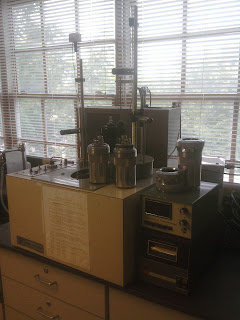
Unfortunately, there are two pieces of equipment that are taking up valuable real estate in the lab that we're having trouble getting rid of. The first is an ancient calorimeter, which is integrated into the benchtop and is connected to a dedicated water line. We've had to request that LU facilities and maintenance come to disconnect it and break it down so that it can be hauled down to surplus.
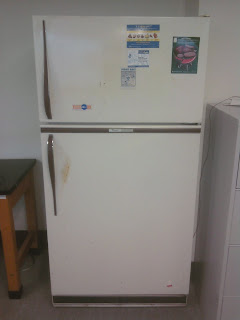
The other item of interest is this old refrigerator. It is packed with biological samples, and of course I was the one who discovered that it had stopped working. I opened the door of the unit to discover a most putrid odor - and a tepid can of Natural Light in the butter dish. We're waiting on the owner of the samples in the fridge to receive a new refrigerator so that he can remove the contents and we can have the old non-functional machine hauled away.
All in all, it's coming together. At least the lab is now useable, which is more than I could have said a month ago. When the last of the old equipment is gone, I'll post some pictures of the lab. Hopefully we'll have some of our fancy new instruments installed by then. I'm wishing now that I would have taken some pictures before we started cleaning so that I could do a before-and-after comparison. But alas, you'll just have to take my word for it that the lab was in a very sorry state of affairs before we moved in.
Unfortunately, there are two pieces of equipment that are taking up valuable real estate in the lab that we're having trouble getting rid of. The first is an ancient calorimeter, which is integrated into the benchtop and is connected to a dedicated water line. We've had to request that LU facilities and maintenance come to disconnect it and break it down so that it can be hauled down to surplus.

The other item of interest is this old refrigerator. It is packed with biological samples, and of course I was the one who discovered that it had stopped working. I opened the door of the unit to discover a most putrid odor - and a tepid can of Natural Light in the butter dish. We're waiting on the owner of the samples in the fridge to receive a new refrigerator so that he can remove the contents and we can have the old non-functional machine hauled away.

All in all, it's coming together. At least the lab is now useable, which is more than I could have said a month ago. When the last of the old equipment is gone, I'll post some pictures of the lab. Hopefully we'll have some of our fancy new instruments installed by then. I'm wishing now that I would have taken some pictures before we started cleaning so that I could do a before-and-after comparison. But alas, you'll just have to take my word for it that the lab was in a very sorry state of affairs before we moved in.
Wednesday, July 6, 2011
Things Are Not What They Appear
So I finally received my Arsenic in the mail the other day. Actually, it's not Arsenic, per se, but a salt compound called sodium arsenate. When the salt is dissolved in water, you then have a mixture containing sodium ions and arsenate ions. Arsenate, commonly referred to as As[V] due to its pentavalent electron structure, is often encountered in nature. And detection and monitoring of arsenate is a research effort of notable interest due to its high toxicity - it is Arsenic after all.
We've set about developing a detection method for arsenate, which is based on one overarching principle of the substance: As[V] quenches fluorescence. This is theoretically true, as the arsenate ion should act as a potent electron acceptor. There are several research groups using fluorescent silole compounds to detect the presence of As[V] via electron quenching in such a manner. See here (subscription required) and here.
But there's a problem with all this. I tried to replicate Stern-Volmer quenching plots for As[V] last week and...well...let's just say I didn't get the same results. My results were not necessarily bad; just unexpected. I'm sure that the data will end up in a manuscript shortly. And once the paper is published - which will be in, like, two years - I'll post a link to it on this blog. Until then, you'll just have to imagine what the data looked like...
We've set about developing a detection method for arsenate, which is based on one overarching principle of the substance: As[V] quenches fluorescence. This is theoretically true, as the arsenate ion should act as a potent electron acceptor. There are several research groups using fluorescent silole compounds to detect the presence of As[V] via electron quenching in such a manner. See here (subscription required) and here.
But there's a problem with all this. I tried to replicate Stern-Volmer quenching plots for As[V] last week and...well...let's just say I didn't get the same results. My results were not necessarily bad; just unexpected. I'm sure that the data will end up in a manuscript shortly. And once the paper is published - which will be in, like, two years - I'll post a link to it on this blog. Until then, you'll just have to imagine what the data looked like...
Thursday, June 30, 2011
Making Enemies is Job #1
I started working at Lincoln University in December of last year. Since that time, a colleague and I have been sharing a lab with a faculty member and space has been tight. We were promised a larger lab right next to our office, but it has been previously used as sort of a community lab space by several researchers. And let's just say habits are hard to break. News went out a couple of weeks ago from university administration that the lab had been handed over wholly to my faculty supervisor. Last week my colleague and I watched with delight as equipment and supplies were cleared from the lab. Over the last couple of days, we have been finishing clearing equipment that won't be used and moving supplies into storage that we won't need.
Unfortunately (but not for me) some of the other researchers came by the lab looking for supplies that had already been tossed out. Oops. Sorry about your bad luck, but the lab was supposed to be cleared weeks ago, actually months ago. And pretty much everyone else in the building got mad because we stacked all of the unwanted equipment in the hallway so that LU Surplus Property could haul it away; they considered it an eyesore. So the equipment was scattered throughout other parts of the building where they would not be so obtrusive. My guess is that they will remain in those out-of-the-way corners for a few more decades. Or until the end of time. Whichever comes first.
The way I look at it: my purpose at LU is to help build the cooperative research program into an advanced, innovation-producing machine. It's difficult to do that with fifty-year-old instruments. My purpose at LU is not to make friends, and so I'm not going to worry too much about making a few enemies.
Unfortunately (but not for me) some of the other researchers came by the lab looking for supplies that had already been tossed out. Oops. Sorry about your bad luck, but the lab was supposed to be cleared weeks ago, actually months ago. And pretty much everyone else in the building got mad because we stacked all of the unwanted equipment in the hallway so that LU Surplus Property could haul it away; they considered it an eyesore. So the equipment was scattered throughout other parts of the building where they would not be so obtrusive. My guess is that they will remain in those out-of-the-way corners for a few more decades. Or until the end of time. Whichever comes first.
The way I look at it: my purpose at LU is to help build the cooperative research program into an advanced, innovation-producing machine. It's difficult to do that with fifty-year-old instruments. My purpose at LU is not to make friends, and so I'm not going to worry too much about making a few enemies.
Monday, June 13, 2011
MUG: It's Not Just For Coffee Anymore

Recently, I have been playing around with a special cell culture media that uses a fluorescent indicator to signal the presence of E. coli bacteria. The culture media is a nutrient broth called LST-MUG, and is often referred to by its proprietary name, Hach media. The nutrient broth is similar to other types of cell culture media, with a couple of notable exceptions. First, the media contains surfactants that inhibit the growth of non-coliform organisms. This basically means that everything but E. coli is killed in the broth, allowing only E. coli to grow in the media. Second, the media contains a molecule called 4-methylumbelliferyl-β-D-glucuronide, or MUG. MUG is the part of the media that is responsible for indicating the presence of E. coli.
Under normal conditions, MUG emits very weak fluorescence at a wavelength down around where blue and UV meet, somewhere around 400 nm, when exposed to UV light. When MUG is introduced to E. coli, it is cleaved (or cut) into two separate smaller molecules by an enzyme within the bacteria called β-glucuronidase. One of the products of this cleavage reaction (the glucoronide part) is basically inert and does nothing at all. But the other product of the reaction is 4-methylumbelliferone, a highly fluorescent molecule. When exposed to the same UV light as before, the fluorescence of 4-methylumbelliferone is easily observable as a pale blue glow. In this way, the MUG acts a fluorogenic reporter of the presence of E. coli bacteria.
This bacterial growth media with the fluorescent reporter is commercially available and widely used to detect the presence of E. coli. However, it has some pitfalls. One problem with the media is that the sample to be tested must be introduced to the broth and then incubated, which is best done in a laboratory environment by a trained technician. A more pressing issue with the broth is its response time, which is 16-24 hours. If you are testing a sample of, say, raw beef, you would take a random in-line sample during processing and inoculate the Hach media. Twenty four hours later, a fluorescent signal is observed in the media, indicating that the beef is contaminated with E. coli. But that particular beef product is already on a truck on its way to the grocery store.
One of the projects that we're focusing on at LU's Center for Nanotechnology & Biosensors is a method for making this process much more effective and drastically faster, so that E. coli can be detected efficiently and contaminated products can be kept off of store shelves.
Thursday, June 9, 2011
Will The Cat Kill Curiosity?

The cat may not kill curiosity, but the federal government just might. A continuous underestimate of the costs required to design, build, and deploy the newest Mars rover has made its future a bit uncertain. You can read more about the ongoing problems with the Mars Science Laboratory here.
I certainly hope that NASA is able to get their house in order with this project.
And speaking of Curiosity, I'll take this as a chance to remind you that NASA's Jet Propulsion Laboratory has a live webcam in the cleanroom where the Mars rover is being assembled. It's pretty cool watching the rover come together, so I recommend following the link if you're interested in that sort of thing.
Subscribe to:
Posts (Atom)

