
Some of you may have already come across this, because it's making big news. But researchers at Argonne National Laboratory have developed what they are calling 'self-assembled colloidal asters.' You can check out the abstract here, but the full article is available by subscription only. These colloidal asters are essentially little micro-robots. They are manipulated with a magnetic field and can perform simple tasks as a cohesive group of colloid particles. If you're interested, I recommend reading Wired Science's article on this, which also includes some pretty cool videos of the little dudes in action.
Wednesday, August 10, 2011


Today's Vocabulary Word: Theory
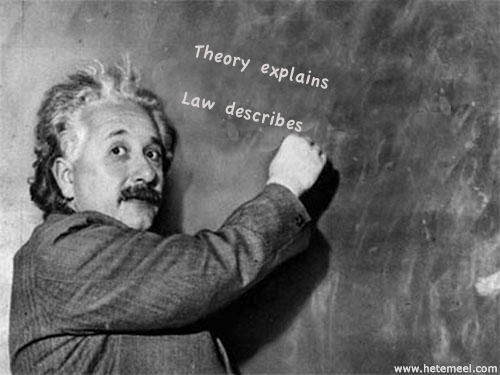 I'm going to go ahead and essentially plagiarize an entire post from one of my new favorite blogs, The Evolving Scientist. I even stole one of the images from their post! Last month, they addressed an issue that has been close to my heart since I was a fledgeling scientist, beating my head against the wall trying to explain evolution by natural selection to the church kids on the school bus. And that issue is the definition of a scientific theory.
I'm not going to rehash their entire post, because they've done an outstanding job of explaining what a theory is and how it is different from a law, as well as how a theory is different from the layman's common definition. But the difference between scientific theory and law is summed up nicely by the image above. A theory is not an educated guess, as many believe (that would be a hypothesis). Instead, a theory is defined (by the Oxford English Dictionary) as 'a scheme or system of ideas or statements held as an explanation or account of a group of facts or phenomena.' In simple terms, a theory is used to explain a set of often complex observations. A law, on the other hand, is a description of an observation, and is often used as a predictive measure when certain conditions exist.

These ideas are, more or less, part of the scientific method, in which observations are used to verify hypotheses and generate scientific theories, thus increasing our understanding of the world around us. This process was spelled out by Francis Bacon in 1620, in one of the greatest works ever written, Novum Organum Scientarium. PZ Myers has a phenomenal post on his blog, Pharyngula, that discusses Novum Organum and its place as a marvelous triumph in human history. If you feel like being inspired by science and our quest for knowledge, it's required reading.
Wednesday, August 3, 2011
Piece By Tiny Little Piece
A quick update before heading off to a meeting: the old lab refrigerator - the one with the Natural Light in it - has been hauled out of the lab by the LU Facilities guys. That freed up a lot of space in the laboratory and got rid of a pretty wretched eyesore. Unfortunately, the old calorimeter is still there. They weren't able to take it along with the fridge because it is still connected to the water supply. This means we'll have to wait for the plumber to come disconnect the instrument, then we'll have to wait for the Facilities guys to come back to pick it up. So it may be there for a while longer.
We're also waiting to have an old non-functional floor centrifuge picked up. The centrifuge is in a lab in the basement. Once they've hauled it away, we're going to move the functional centrifuge that's currently in our lab down to take the old one's place. Then we'll be putting the new refrigerator in the space left by the centrifuge.
After all this is done, it's going to look pretty awesome in the new lab. Everything will be arranged very efficiently and we'll have lots of extra space on the bench top for all of the equipment that has been ordered or will be ordered in the near future.
Speaking of equipment, I also moved our spectrofluorometer up into the lab from downstairs. This is a pretty big deal since it's the instrument that we use most often for fluorescence measurements. It wasn't easy, since the fluorometer is a pretty big unit - taking up most of the bench that it now sits on. I had to break the instrument itself in half and carry it up into the lab on a cart. Then I had to bring up all of the drivers and amplifiers and other peripheral equipment that runs the machine. It's a fairly delicate and complicated instrument, so it took me some time to get it put back together and hooked up properly, but it's going to be nice to have it in our lab where it will be easily accessible. It was starting to become a real pain in the ass to prepare the samples in the new lab, then carry them downstairs to the old lab to take the measurements.
We're also waiting to have an old non-functional floor centrifuge picked up. The centrifuge is in a lab in the basement. Once they've hauled it away, we're going to move the functional centrifuge that's currently in our lab down to take the old one's place. Then we'll be putting the new refrigerator in the space left by the centrifuge.
After all this is done, it's going to look pretty awesome in the new lab. Everything will be arranged very efficiently and we'll have lots of extra space on the bench top for all of the equipment that has been ordered or will be ordered in the near future.
Speaking of equipment, I also moved our spectrofluorometer up into the lab from downstairs. This is a pretty big deal since it's the instrument that we use most often for fluorescence measurements. It wasn't easy, since the fluorometer is a pretty big unit - taking up most of the bench that it now sits on. I had to break the instrument itself in half and carry it up into the lab on a cart. Then I had to bring up all of the drivers and amplifiers and other peripheral equipment that runs the machine. It's a fairly delicate and complicated instrument, so it took me some time to get it put back together and hooked up properly, but it's going to be nice to have it in our lab where it will be easily accessible. It was starting to become a real pain in the ass to prepare the samples in the new lab, then carry them downstairs to the old lab to take the measurements.
Wednesday, July 27, 2011
Putting on the Blinders

Back in the early days of this blog, I made mention of the James Webb Space Telescope (JWST). The JWST is set to take the place of the Hubble, now that the Hubble is in semi-retirement. Then, as now, I'm really excited about the JWST. One of its primary missions will be to peer back to the beginnings of the Universe; back to the time when light first came into existence.
That is seriously awesome. It's like time travel, but not.
And now, on top of everything else falling apart around us, it looks like congress may use the federal budget deficit as an excuse to cut the program. A program, by the way, this is nearly complete. As I learned via Pharyngula today, cancellation of the JWST project is eminent. I recommend following that last link and reading the column by Lawrence Krauss. It is powerful, concise, and says more about this potential tragedy than I ever could.
Tuesday, July 26, 2011
Getting Into It
I've been trying to broaden by horizons a little bit by expanding the number and scope of other blogs that I read each morning. A while back I posted a list of the blogs that I've been reading as I sit down with a cup of coffee to check my email and take care of other morning duties. I guess it's now time to add another recommendation to the list. I've been getting into a blog called The Evolving Scientist. The blog is authored by a group of five graduate students at the University of Kentucky, which I have a bit of fondness for as I spent some time on the UK campus when my then-girlfriend, now-wife was working at the Frankfort State-Journal.
The authors of The Evolving Scientist do some fun things with their blog. The tag line changes almost daily but retains a theme of 'five guys with a love of science.' I should note here that they've added another author to the list within the last few days, and this addition has made their tag line a little misleading. Not only is the group now composed of six authors, but the newest author is female. So I guess it's more like 'five guys and one chick with a love of science.'
Anyways, the blog is lighthearted and enjoyable to read. The authors are all biologists, though, so I only have a passing interest in their more technical entries. They also feature a podcast, which I must admit, I have not listened to. It seems as though this is the centerpiece of the blog, and I may be totally missing out on something. But I prefer to spend my mornings reading rather than plugging earbuds into my head and zoning out. And you can forget about listening and reading simultaneously. I wouldn't retain information from either source. It would be as if I hadn't read the blog or heard the podcast. My brain would just sort of shut down. It does that more often than I'd like to admit.
The authors of The Evolving Scientist do some fun things with their blog. The tag line changes almost daily but retains a theme of 'five guys with a love of science.' I should note here that they've added another author to the list within the last few days, and this addition has made their tag line a little misleading. Not only is the group now composed of six authors, but the newest author is female. So I guess it's more like 'five guys and one chick with a love of science.'
Anyways, the blog is lighthearted and enjoyable to read. The authors are all biologists, though, so I only have a passing interest in their more technical entries. They also feature a podcast, which I must admit, I have not listened to. It seems as though this is the centerpiece of the blog, and I may be totally missing out on something. But I prefer to spend my mornings reading rather than plugging earbuds into my head and zoning out. And you can forget about listening and reading simultaneously. I wouldn't retain information from either source. It would be as if I hadn't read the blog or heard the podcast. My brain would just sort of shut down. It does that more often than I'd like to admit.
Monday, July 25, 2011
You Call That a Review? Part II
Just quick follow-up note to my post titled 'You Call That a Review?' The post described the lame reviewer comments that I received for a manuscript that I recently submitted to an academic journal. I mentioned near the beginning of that post that I believed my paper would inevitably be published. Sure enough, I received word over the weekend that my paper has been accepted for publication. No idea yet when this will happen, but when the electronic version goes up , I'll link to it here on this blog. I'll also try to provide a few notes as well - in less technical terms than the paper itself.
Wednesday, July 20, 2011
Do You Want The Bad News or The Bad News First?

First, I'm going to start with what is probably the least significant bad news in the grand scheme of things. I arrived onto campus this morning to find that my building does not have air conditioning. As I write this, it is not quite 9:00 am, and the thermostat in my office just hit 80 degrees and is rising fast. I mean, seriously, it's like the hottest week in human history and the air conditioning decides to peter out now? Let me tell you, if it wasn't 9 am, I'd be packing up my computer and heading to the pub to do my proposal writing with a cold refreshing craft beer. Not that I have anything against enjoying an adult beverage in the morning. The pub just isn't open yet.
Now for the other bad news, which is somewhat more important than my mild discomfort. While reading through one of my new favorite blogs, The Evolving Scientist, I ran across this post. It looks like NASA and the NSF are going to see significant cuts in their budgets. And that means less money being sent down the pipe to researchers like me in the form of research grants. Even more troubling is that this will also mean less money being spent on science education, which is one of NSF's primary directives. I suppose this was inevitable, as we are currently creeping through what is being called the Lesser Depression - the result of the 2008-2009 economic recession and the subsequent and continuing lack of action by the federal government. It still really sucks, though.
Subscribe to:
Posts (Atom)

