Monday, November 22, 2010

Shmorgisborg of Science


During my dissertation defense presentation a couple of weeks ago, I explained that one of the advantages of any fluorescence-based biological or chemical detection system would be the ability to scale down such a system to a portable and deployable size. My evidence for this was the mention of two biosensing detection systems commercialized by Research International: the Raptor and the Biohawk. Both of these systems are, for lack of a better word, awesome. Both systems use what are known as sandwich immunoassays to detect the target analytes. And both systems are capable of detecting multiple analytes simultaneously. The sandwich immunoassay used in these sensors is an antibody-based detection method in which a primary antibody specific to a target compound is adsorbed onto a glass waveguide, similar to an optical fiber. If the target compound is present in a sample, it will bind selectively to the primary antibody. After exposure to a sample, a solution containing a secondary antibody that is labeled with a fluorescent dye is flown over the waveguide. If the target compound is bound to the primary antibody, the secondary antibody will also bind to it, creating a sort of antibody-antigen-antibody sandwich (hence the name of the assay). Excitation light is then sent through the waveguide, exciting the fluorescent dye bound to the secondary antibody, indicating the presence of the target compound.

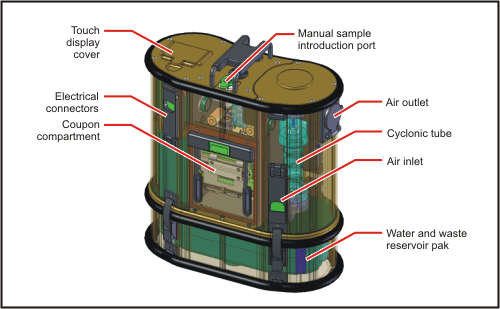
I remember learning about RI's Raptor sensor during my coursework early in my graduate studies, so it has been around for quite some time and has become a bit of a mainstay. Certainly if you'd like to learn more about either of these systems, you can check out Research International's website and read up about them. Besides plenty of reading material, there are some really nice diagrams on how the sandwich immunoassay works, as well as diagrams showing the inner workings of a fully automated biosensor. They also have some other cool detection and sampling platforms that are worth checking out if you're interested in those types of things.

And now for some news.

As if CERN hadn't made headlines enough lately (see Large Hadron Collider), they made big news last week when they announced and published the results of their recent studies on antimatter. One of two research groups working on parallel studies was able to effectively create atoms of antihydrogen, hold them in an electromagnetic field, and keep them there for nearly 200 milliseconds. Although this is a big deal, the end goal is to create and trap many more antihydrogens and to hold them for much longer periods of time so that the properties of the trapped antimatter can be thoroughly studied and examined. And so this study is a major step forward in regard to the overall objective.

And there you have it, folks. A blog update with actual substance. Been a while.

Tuesday, November 16, 2010

It's a Celebration!

A quick update on how things are going with the author: on Wednesday November 10th, I successfully defended my doctorate dissertation. Technically, I am not yet a doctor, as the Mizzou graduate school has not received my forms and dissertation, but I am hoping that all of the paperwork will be submitted within the next week or so. So what I'm getting at here is that if you feel like calling me Dr. Stringer, I would be comfortable with that.

So what's next, you ask? That's still a little up in the air. I was interviewed by a company that I really liked, but did not get the job. Instead, I will likely take a post-doc position and stay here in Columbia. It's all worked out pretty well considering I've grown to like Columbia quite a lot. In addition, the post-doc position will allow me to work on some unfinished research that I was just beginning as I was writing my dissertation.

For now, I'm going to have to leave it at that. I'll be updating soon with some information on some very cool, already-on-the-market biosensing systems that I discussed briefly during my defense. Until then, the doctor is on-call.

Monday, November 1, 2010

Curiosity Didn't Kill the Cat, But It Could if It Wanted To


Oh wow. I can't believe it's been over a month since I've updated this thing. But I guess that's how it goes when you're preparing for a final defense and trying to pin down a job for after graduation. Add my current position as live-in babysitter and sprinkle in a little part-time work in the lab getting a pilot study going, and you've got a daily schedule that leaves very little room for blogging.

For those who are interested, my final defense will be November 10th at 10:00am in room 259 of the Agriculture Engineering Building. The defense presentation will be public, so come by if you'd like.

Now for my main reason for creating this post: as a follower of NASA's Twitter feed, I was informed of this live video of the assembly of the next generation Mars rover, called Curiosity. I believe that the folks you see working in the clean room are currently assembling the robotic arm of the rover at the time of posting this. If you're getting to this post, and therefore the link, much later than when this update was posted, I'm not sure what you'll see. But it appears as though you'll find some sort of rover assembly at that URL for quite some time. Anyways, it's pretty awesome, so I recommend checking it out.

Posting will probably continue to be intermittent (or nonexistent) for at least the next week and a half or so. I will try to begin adding regular updates after my defense, but it will be crunch time for getting a job and moving, so we'll see how it goes. Until next time, enjoy watching assembly of the Mars rover...or whatever else happens to be at that particular URL when you click the link.

Tuesday, August 17, 2010

Call Me a Derelict Once Again


Wow. It's been a long time since I've posted. Turns out that fatherhood is a fairly time-consuming venture. And when you combine it with writing a dissertation, conducting research, and job-hunting...well let's just say my days are certainly full.

I have to say that there were a couple of fairly major events that happened recently that I would've liked to blog about. First was the Perseid meteor shower, which peaked late last week. I guess we haven't totally missed that one, considering that if you live in a region with relatively low light pollution, you can probably still glimpse a few meteoroids per hour. If you're lucky. The other event that I would've liked to have posted on here was yesterday's live streaming video feed of the repairs being made to the International Space Station. The series of spacewalks that took place were undertaken to repair a faulty pump that is used to cool the station and its components. I watched a few minutes of the video feed, and what I saw of it was pretty fascinating. Most of the feed was focused on the ground crew, who we saw conversing idly, as well as eating lunch (I saw one tech eating a sandwich and found myself wondering, 'what kind of sandwich is that?'). But I did get to see some of the live video from the camera that appeared to be fixed to the astronaut's helmet. From that camera, I watched as the astronaut basically just tried to get from one point to another; either trying to reach the repair site or trying to return to the ISS exterior hatch. The really interesting part was how the astronaut made his or her way across the surface of the station using a series of handles. It was slow going, but probably very reassuring to always have at least one hand on something solid.

Anyways, I'm not sure if I'll be back to regular posting or not. We'll see how it goes. I'll try to update at least every week or two, though. In the meantime, I'll try to keep my chops up by continuing to watch Carl Sagan's Cosmos with my son, and as many episodes of Nova as I can.

Friday, July 9, 2010

How Do You Say 'Mark It, Dude' In Swiss?


One thing is for certain: there's nothing eco-friendly about travel by airline. Aircraft engines sputter huge amounts of pollutants while in the air. Another certainty is that our skies are only becoming more and more congested with these noisy, fuming creatures. To remedy this problem, the governments of the U.S. and Europe have considered various measures for curbing airline pollution, such as taxes, emission standards, etc. But really, as more airlines take flight everyday, it's unlikely that these measures will make any long-term positive impact.

This is where Solar Impulse comes onto the scene. As of yesterday morning, the first night flight by a solar-powered aircraft was completed. Solar Impulse's HB-SIA aircraft lifted off the previous morning in Switzerland, spent the day charging its batteries at high altitude, and then spent the night running solely on those batteries thanks to the four electric engines that propel the craft. After 26 hours of flight, the HB-SIA returned to its home airfield and landed.

The plane itself is really quite simple. Essentially, it is a lightweight glider with an immense wingspan fitted with four electric propeller engines. The top of the extra-wide wing is covered with thousands of solar cells, which charge the polymer lithium batteries. And dangling from underneath the expanse of wing is a small cockpit that holds only one pilot. After its first successful night flight, the Solar Impulse team's next challenges include a trans-Atlantic flight and a round-the-world flight, both slated to be attempted within the next 3 years.

It should be noted that the power required to keep a large airliner packed with travelers in the sky is quite immense, so don't expect to see a fleet of solar-powered Boeing 747s anytime soon. But it is reasonable to think of this flight as a rather large leap in that direction. After all, it wasn't really all that long ago that sustained passenger flight was considered impossible even with conventional aircraft (Lindbergh's solo flight across the Atlantic took place just over 83 years ago). If you want to hear my prediction (which I know you don't because it means absolutely nothing...I'm not an expert in aviation or renewable energy), I'd be willing to bet that I will fly on a solar-powered aircraft in my lifetime.

So there.

Friday, July 2, 2010

In Space, No One Can Hear You Whimper


My current reading material is Richard Dawkins' latest book, The Greatest Show on Earth: The Evidence for Evolution. It's the first Dawkins book that I've read, and although I'm very much enjoying it, I find him so overly pretentious and oftentimes contradicting himself throughout the book that I have to take frequent reading breaks to ensure that I am not assimilated by the Borg of smugness (Star Trek reference - kicking the nerd factor up another notch). It was during one of these reading breaks that I switched on the television yesterday evening and looked through our selection of on-demand Netflix items. While perusing through the various childrens' shows and lame reality TV programs, I happened upon a series titled When We Left Earth. I vaguely remember this show airing on Discovery Channel, but since I don't have cable, I hadn't seen any of the episodes. As one might expect, this is a television show dedicated to the history of NASA and of manned space flight. I only watched the first episode, which covered the Mercury Program and the initial seven American astronauts, but I can't wait to watch the rest of the series. In fact, all day I've been looking forward to plopping down in front of the TV with an adult beverage and watching another episode or two.

I bring this up not just because I'm plugging the show and believe that it should be required material for school children, but also because it drew my thoughts to one of my favorite books: The Right Stuff by Tom Wolfe. So not only am I shamelessly plugging a show about manned space flight, I'm also plugging a book about manned space flight. And I must say that if space flight fascinates you to any degree, you must pick up a copy of The Right Stuff and give it a read. But I should warn you that if your fascination with space flight is as intense as mine, you will have difficultly putting it down and other tasks will take second priority. So don't plan on being real productive once you get started with that one.

While watching When We Left Earth, I found myself thinking about a certain fact about myself, which is that while I am completely awe-stricken by manned space flight and still to this day floored by the idea that a man walked on the moon, I have very little interest in going into space. This concept was hammered home last night during the introductory sequence of the show, in which one of the images we see are an astronaut in orbit with the features of the Earth gliding by behind him.

And that's when I started feeling a little queasy.

Yes, I'm infatuated with manned space flight. But if you sent me into space, stuffed me into a suit and pushed me out the door, I'd grab onto the first thing thing I could get a hold of, with arms and legs, and hold tight until it was time to go back in. The thought of being out there, in the vastness of space, somewhat terrifies me. With that said, if someone from NASA came to me and said, "Cody, we'd like to send you to space. How about it?" I'm not sure that I'd be able to say no. I'd just probably spend the whole trip quaking with fear. And probably crying a little bit.

Friday, June 25, 2010

Lungs and Penguins; But Not Penguins' Lungs

I have returned to the wonderful town of Columbia after a successful trip to Ft. Leonard Wood and back yesterday. My plenary talk went quite well. And although I didn't see any earth-shattering presentations or hear of any bewilderingly awesome research, I did meet some really nice people. I had hoped to at least have a few nuggets from my day at Leonard Wood to discuss on this blog, but alas, I returned with very little noteworthy nerd-stuff.

I will say this: Ft. Leonard Wood is a strange place. Everyone wears the same outfit. They travel in large groups, often singing monotonous chants in unison. And perhaps I'm the only one who finds this odd, but despite the fact that the fort does not cover an overtly large area, everyone drives everywhere they go. Even though the early summer weather yesterday was seasonably mild, I did not see a single person walking or riding a bike.

With the understanding that my previous post was fairly scant and lacking any real substance, I am unfortunately going to have to leave this post in the same state. My day of travel was quite tiring and I'm having a hard time focusing, or for even functioning for that matter, today. Maybe my next post should be on the science of sleep; perhaps I'll learn a thing or two and will be able to stay alert enough to keep this blog going. I will, however, leave you with two items of interest before I fall asleep at my desk. The first item (actually, two items combined into one) is an article on creating lungs in a laboratory. The two studies that are featured in the article were both published in Science, and describe two methods for engineering a lung, or at least a device that performs a similar function. The first study is actually a biologically engineered lung, in which lung tissue was decullularized, and then the decelled platform was subsequently reseeded with lung cells. The cells, using the extracellular matrix of the decellularized platform as a guide, grew into the correct positions so that the lung was effectively recreated. The second study was a microfluidic device, wherein the fluidic channel was lined with lung cells. Outside of the channel were blood capillaries, which gave each device the function of a single alveolus of the lung. Both studies were pretty cool and I'm constantly amazed at the advances in tissue engineering. And generally speaking, both of these were pretty big advances.

The second item that I would like to leave you with is a video of a penguin that I took while at the Shedd Aquarium last month. Why? Because penguins are totally awesome!

Enjoy!